

-
How to swerve the Emissions Trading hit - 2 days ago
-
Hai Robotics’ HaiPick Climb Reaches 10,000-Robot Milestone Across Global Customer Projects - 2 days ago
-
Nulogy to showcase Smart Factory and Quality & Compliance solutions at PPMA 2026 - August 27, 2026
-
ENTERPRISE FLEX-E-RENT TARGETS FLEET DIGITISATION INNOVATION WITH SURECAM PARTNERSHIP - August 27, 2026
-
PROLOG FURTHER STRENGTHENS COMMERCIAL TEAM WITH APPOINTMENT OF BUSINESS DEVELOPMENT MANAGER - August 25, 2026
-
GOPLASTICPALLETS.COM LAUNCHES UK’S LIGHTEST EURO PLASTICPALLET TO BOOST EXPORT EFFICIENCY - August 19, 2026
-
QUECLINK PROVIDES FLEET AND ASSET TRACKING BOOST FOR THE FREIGHT AND LOGISTICS SECTOR - August 18, 2026
-
Shuttle technology and integration expertise: Jungheinrich and Movu Robotics agree strategic partnership - August 13, 2026
-
AUTHENTICITY SELLS: WHY GREAT INFLUENCER CAMPAIGNS DEPEND ON GREAT FULFILMENT - August 10, 2026
-
ROAD TRANSPORT OPERATORS TURNING TO TECHNOLOGY FOR ADVANCED PROTECTION AGAINST FUEL THEFT RISK - August 5, 2026
Entire warehouse equipped with lithium-ion.
Linde customers can now perform the majority of logistics tasks in the warehouse using lithium-ion technology.
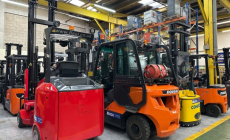
Many an industrial truck operator considers switching from lead-acid batteries to lithium-ion technology when it comes to investing in new trucks. This is due to the numerous advantages this technology offers: rapid (intermediate) charging, no battery changes, excellent performance thanks to high energy density and constant power output, long battery life and freedom from maintenance. With more than 30 other such warehouse trucks added to the portfolio of Linde Material Handling – including pallet stackers, double stackers, order pickers, and reach trucks –, customers can now fulfill the majority of logistics tasks in the warehouse with Li-ION variants.
More specifically, the expanded range of lithium-ion models encompasses pallet stackers and double stackers in the load range of 1.2 to 1.6 tons, which are available either as pedestrian trucks or as models with foldable or fixed stand-on platform. In addition, the product spectrum includes low-level order pickers with 2.0 tons load capacity and reach trucks in the load range of 1.0 to 2.5 tons.
Together with the pre-existing models, such as low-level order pickers and tow tractors, all key areas of application in the warehouse can now be covered using lithium-ion technology: from truck ramp to goods storage and retrieval in the high-rack warehouse, from order picking to the provision of goods for shipping. “Our range now includes ‘lithium-ion’ options for all of the highest-volume segments in warehouse technology, which means that we have taken a decisive step on our way to becoming a full-range provider for this battery technology,” says Christoph Englert, Product Manager Industrial Trucks at Linde. “We’re receiving extensive positive feedback from our customers regarding long-term operation. In particular, they are full of praise for the batteries’ steady voltage output which is constant right up until complete discharge and they are extremely satisfied with the high level of availability as this allows them to benefit from higher performance and reduced costs.”
To make the most of the performance advantages offered by the new battery technology, the individual components – battery, battery management function and charger – have been designed by Linde as a complete system and communicate with each other via CAN bus. “The battery management system monitors and controls the battery and ensures that it always operates in the optimal performance range,” emphasizes Englert. The entire package comes with a CE mark, and the batteries have been extensively tested and feature a multiple protection system.
According to the load capacity of the pallet stackers, double stackers and order pickers, which operate in the 24V range, there are four battery sizes available, ranging from 1.8 kWh to 9.0 kWh. For the reach trucks, which operate on a voltage of 48V, battery sizes of up to 39.2 kWh are on offer. Each battery can be combined with three different chargers – depending on how often and for how long (intermediate) charging is possible and what demands customers make regarding recharging speed. In the best of cases, it takes just 70 minutes for the Li-ION battery pack to fully recharge.