
-
Prism delivers dairy industry-first sustainable packaging solution for Bio&Me - 3 hours ago
-
Nulogy Intelligence Launch Brings AI to the Plant Floor - May 29, 2026
-
Thorworld hosts Chesterfield MP to discuss impact of steel tariffs on UK manufacturing - May 28, 2026
-
Industrial Maintenance Teams Get Digital Workers - May 28, 2026
-
Rushlift presents full-service offering at Royal Norfolk Show - May 28, 2026
-
International Plastic Free Day: Why plastic-free doesn’t always mean more environmentally friendly - May 22, 2026
-
Cleantech REPS gets $23.6M to turn road traffic into clean electricity at scale - May 22, 2026
-
Reaching out to the Middle East - May 22, 2026
-
AVIAN raises $2.6M to scale AI thermal monitoring for the world’s most fire-prone industrial sites - May 20, 2026
-
Articulating warehouse cost reductions in five steps - May 15, 2026
LogiMAT world premier: Fraunhofer IML and EPAL leveraging data in the logistics sector.
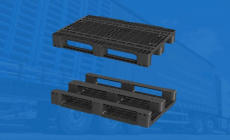
The Fraunhofer Institute for Material Flow and Logistics IML and the European Pallet Association e.V (EPAL) are developing the load carriers of the future at the newest Enterprise Lab in Dortmund (Germany). The first application of the interactive pallet was made public by the partners at LogiMAT 2018.
To release the most valuable data potential of the logistics sector, the Fraunhofer IML and EPAL took up the cause with the newest Enterprise Lab in Dortmund. The aim of this joint development is to digitalise the world’s largest open pallet pool. The standard Euro pallet is the most important load carrier in the logistics sector. Many systems in conveyer and storage technology, handling and packaging are designed on EPAL Euro pallets. In Europe alone, the Association has over 500 million pallets in circulation.
“The logistics sector is based on the pallet. Making these intelligent, means making the logistics sector intelligent. Intelligent pallet networks are a milestone on the way to the Internet of Things which can leverage the real data potential of the logistics sector”, comments Professor Dr Michael ten Hompel, Managing Director of the Fraunhofer IML.
The demand for load carriers that can be automatically traced and controlled is currently rapidly increasing thanks to Industry 4.0. The most important tool is a new interactive pallet, which not only serves as a load carrier, but also as an information carrier. It is also in able use smart devices to communicate in a decentralised network. In an integrated total system of 500 million pallets, there is a business case, which includes a corresponding IT infrastructure as well as the development of suitable apps for mobile end devices.
“Cooperation with the Fraunhofer IML gives us access to experts who have comprehensive know-how at their fingertips, both in technology development and drafting business cases. So the Institute for us, as operator of the world’s largest pallet pool, is the ideal partner to help us reach the digital future”, explains Mr Robert Holliger, President of EPAL.
The application of communicating pallets shown at LogiMAT is based on the wireless technology “NarrowBand IoT”. This solution has been developed as part of the joint research activities of the Fraunhofer IML and Deutsche Telekom (the German telecommunications company), at the recently founded “Telekom Open IoT Lab”. “It has become evident, that NarrowBand IoT is the perfect technology for implementing the Internet of Things in the logistics sector. The technology transfer at our Fraunhofer Lab Center was logical and impressively demonstrates the advantages of interdisciplinary research in one place, says ten Hompel.
The “Fraunhofer Enterprise Labs” have established themselves as a model for success since 2013: After Deutsche Telekom, Dachser SE, Rhenus SE & Co. KG, Boehringer Ingelheim*, BMW Group,
DB Schenker AG, Audi AG*, the Würth-Gruppe and Sick AG, EPAL is now the tenth company which has chosen this innovative type of joint research into industry and science.
The Fraunhofer IML is introducing the first interactive EPAL pallet at LogiMAT 2018 in Hall 1, Stand K61.
*in cooperation with the Fraunhofer Institute for Software and Systems Engineering, in Dortmund