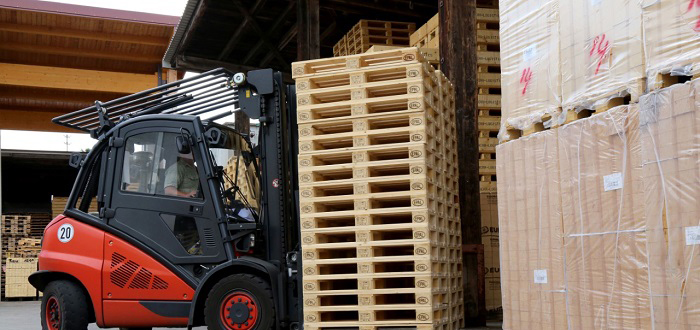
EPAL UK & Ireland has reported pallet sales increases of 13 per cent in the third quarter of 2020, as businesses prepare for the final Brexit cut off on December 31. The open-loop pallet pooler manufactures and repairs all its pallets to an ISPM15-compliant standard, meaning they conform to regulations governing packaging movements that come into force on January 1 next year.
Wooden pallets and packaging that originate within the European Union are generally free to move between member states without having to meet international ISPM15 standards. However, when the UK leaves the EU, regulations state they must be heat-treated and marked as ISPM15-compliant when travelling in either direction between the UK and the EU. This means they may be subject to official checks that may delay shipments for a period immediately after Brexit.
The timber packaging and pallet industry has worked hard with industry and the UK government to build up stocks of compliant wooden pallets and packaging, expanding the country’s kilning capacity and announcing that ISPM15-marked components can be used to repair used pallets, for example. Nevertheless, EPAL’s chairman says some companies have sought out guaranteed sources of ISPM15 compliancy such as EPAL.
Paul Davidson, Chairman of EPAL UK & Ireland, said: “We have seen a rise in demand from businesses wishing to eliminate completely the risks to their supply chains of the new regulations. When pallets are ISPM15-compliant, they are free to move through customs across Europe, and throughout the world, and won’t be the source of unnecessary details; so business have been looking for established suppliers. As EPAL pallets are kiln dried to ISPM15 specifications as standard, they automatically conform to these regulations.”
Other benefits of using EPAL pallets are that they are: safe for loads of up to 1.25 tonnes; kiln-dried, giving them extra strength and durability; and specified ‘as new’ whenever they are repaired.