why businesses stay with fulfilment partners that no longer deliver
by Steph Mitcheson, Business Development Director Prolog Fulfilment
In boardrooms and operations meetings across the retail sector, a familiar conversation regularly takes place. Sales are growing, customer expectations are rising, and fulfilment performance is becoming increasingly critical to brand reputation. Yet despite frustrations with their current e-fulfilment provider, many organisations remain reluctant to make a change.
For many people this seems irrational. If service levels are inconsistent, costs are increasing, or customer complaints are mounting, why wouldn’t a business simply move to a better provider or one that is more suited to their needs?
As someone who has worked in the sector for many years, on both sides of the fence, I get it. The answer lies in the perception of the complexity of this operational change.
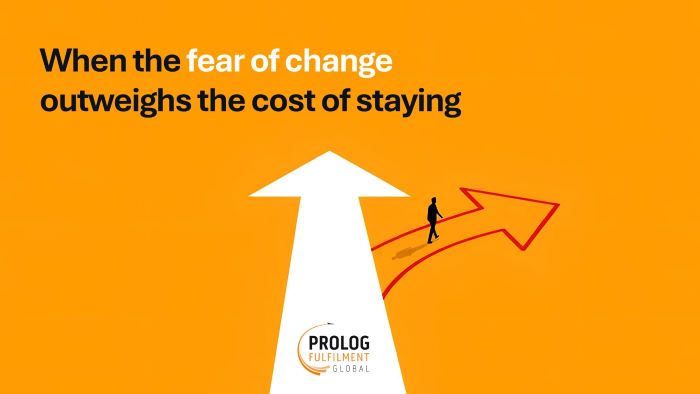
The Cost of Switching often feels Greater than the Cost of Staying
Changing an e-fulfilment partner is not comparable to changing a software subscription or office supplier. Fulfilment sits at the heart of the customer experience and touches inventory management, technology integrations, warehouse operations, carrier relationships, finance processes, and customer service.
Any transition carries risk. Inventory must be transferred, systems reconfigured, staff retrained, and service continuity maintained. For many executives, the prospect of this disruption outweighs the pain of ongoing dissatisfaction.
As a result, businesses frequently conclude that a mediocre but predictable service is preferable to the uncertainty of a major transition.
Institutional Inertia Is Powerful
Some organisations are naturally resistant to change. Existing processes become embedded over time, and teams learn how to work around deficiencies in their fulfilment operation.
What begins as a temporary workaround often evolves into standard practice. Internal stakeholders become accustomed to compensating for supplier shortcomings, creating an environment where inefficiencies are tolerated rather than challenged.
This organisational inertia can make the status quo surprisingly resilient.
Fear of Making Things Worse
One of the most significant barriers to switching providers can be psychological rather than operational.
Decision-makers who approved the current fulfilment arrangement may be reluctant to admit that it is no longer meeting expectations. Meanwhile, those proposing change must demonstrate not only that a new provider is better, but that the transition itself will not create new problems.
In many cases, the question is not “Can we find a better partner?” but rather “What if the replacement turns out to be worse?”
This fear often delays action long after warning signs have become apparent.
The Hidden Complexity of Fulfilment
Modern e-commerce fulfilment is highly interconnected. Warehouse management systems, ERP platforms, marketplaces, websites, courier networks, returns processes, and inventory forecasting all depend on accurate and timely data flows.
Even when a business is dissatisfied with service levels, the existing provider may possess years of operational knowledge about products, customer requirements, and bespoke processes.
The perception is that replicating that knowledge elsewhere is hard.
Lack of a Clear Business Case
Interestingly, dissatisfaction alone is seldom enough to justify change.
Senior leadership teams typically require a compelling financial rationale before approving a fulfilment transition. Service frustrations may be visible, but unless they can be translated into measurable costs such as lost customers, increased returns, or missed revenue opportunities, the argument for change often struggles to gain traction.
Without quantifiable evidence, businesses can remain trapped between dissatisfaction and indecision.
Relationships Matter
Long-term commercial relationships also play a role. Fulfilment providers often become trusted partners over many years. Personal relationships develop between operational teams, account managers, and executives.
These relationships can create goodwill that buys providers additional time to resolve issues, even when performance is falling short.
In some cases, loyalty delays necessary change.
When Organisations Finally Decide to Move
Most businesses do not switch fulfilment providers because of a single incident. Rather, the decision usually follows a gradual accumulation of concerns.
Rising costs, missed service-level agreements, limited scalability, technology constraints, and customer complaints slowly erode confidence. Eventually, the perceived risk of staying exceeds the perceived risk of leaving.
At that point, change becomes inevitable.
Making the Transition Less Daunting
The reality is that many organisations are not looking for a new fulfilment provider; they are looking for a low-risk path to improvement. This is where specialist fulfilment partners can make a significant difference. Providers that combine operational expertise with structured onboarding, robust technology integration, and dedicated migration support can remove much of the uncertainty that often prevents businesses from making a change.
For brands seeking both UK and international growth, the challenge becomes even greater. The fulfilment partner must not only deliver operational excellence but also provide the infrastructure and expertise needed to support multi-channel, cross-border commerce.
Conclusion
At Prolog Fulfilment we have a proven reputation in providing scalable e-fulfilment, warehousing, returns management, carrier management, and international distribution solutions designed to support growing retail and e-commerce brands.
We also know that this is not always enough to make organisations make the move.
By providing a comprehensive onboarding and focusing on seamless implementation and operational continuity, we work hard to reduce the risks that organisations traditionally associate with changing fulfilment providers.